
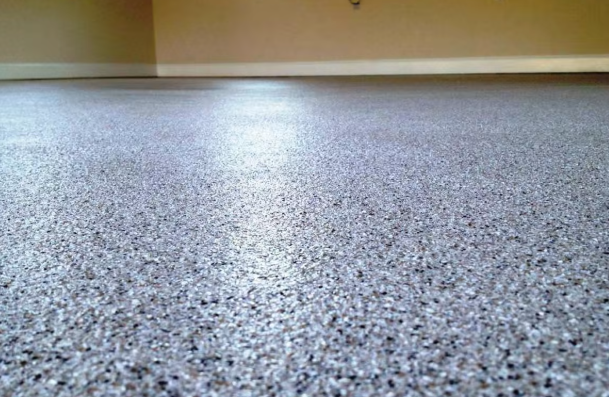
A garage floor takes more abuse than its clean finish may suggest. Polyaspartic topcoats add a protective layer over epoxy flooring that helps resist abrasion, chemicals, sunlight, and daily vehicle traffic. Unlike a decorative finish alone, this final coat plays a direct role in how well the completed floor holds up over time.
Why Put a Polyaspartic Topcoat Over Epoxy?
Surface protection becomes especially important once an epoxy base coat has cured. Epoxy creates a strong bond with prepared concrete, but the exposed surface can still develop scratches, stains, or discoloration depending on the formulation and conditions inside the garage.
Daily traffic places stress on the uppermost layer first. That is why many professional systems pair epoxy with a polyaspartic topcoat instead of leaving the base material exposed. Clear polyaspartic seals the color or decorative flakes beneath it while forming a harder wearing surface above.
Better Resistance Against Tire Wear and Abrasion
Garage tires bring sand, grit, small stones, and road debris onto the floor. Hot rubber also presses firmly against the coating after a vehicle has been driven for miles, while steering in place creates additional friction.
Road grit can act like sandpaper as vehicles move across epoxy floors. Because polyaspartic coatings offer strong abrasion resistance, the top layer absorbs much of this routine wear before it reaches the decorative system underneath. Homeowners comparing results for an epoxy garage floor near me should ask what material protects the final surface, not only what resin forms the base coat.
Decorative Flakes Stay Sealed Beneath a Durable Finish
Decorative chips become embedded in the wet base coat during installation. Full-broadcast systems use enough material to cover the underlying color, creating a dense layer that improves texture and hides minor visual imperfections.
After curing, installers scrape away loose or upright flakes before sealing the surface. Textured areas then receive a clear topcoat that locks the remaining chips into place and keeps dirt from collecting between their edges. Searches for epoxy floors near me often show flake systems with a glossy finish, but the clear layer also performs an important protective job.
How Does a Polyaspartic Topcoat Affect Traction?
Fine texture can help a garage floor feel more secure underfoot, especially where water enters from wet vehicles. Installers can adjust traction by controlling the flake profile, topcoat thickness, and amount of slip-resistant aggregate mixed into the finish.
Still, more texture is not always better. Deep surfaces can hold dirt and become harder to mop, while overly smooth finishes may feel slick when wet. Professional epoxy floor companies balance these factors according to how the garage or commercial space will actually be used.
Sunlight Can Be Hard on Unprotected Epoxy
Sunlight entering through open garage doors or windows can affect certain epoxy formulations over time. Epoxy may amber or shift in color after prolonged ultraviolet exposure, especially in areas that receive stronger daylight than the rest of the room.
Polyaspartic topcoats generally offer better UV stability than standard epoxy and can help preserve the appearance of the system underneath. Compared with leaving the epoxy exposed, this added layer makes sense for garages that receive regular afternoon sun or have large openings facing direct daylight. Property owners searching for epoxy flooring near me may want to ask how the proposed system handles UV exposure.
Chemical Resistance Matters in Garages and Work Areas
Commercial and residential floors regularly come into contact with substances that ordinary paint cannot handle well. Forklifts and machinery may leak hydraulic fluid, while household garages can see motor oil, gasoline, cleaners, brake fluid, and other automotive products.
Frequent exposure makes the topcoat an important part of commercial epoxy flooring as well as residential systems. Facility owners should confirm which chemicals the selected product can tolerate because resistance varies among formulations. Correct cleanup also matters, since even durable coatings should not be used as permanent containment for harsh chemicals.
Faster Curing Changes How the Topcoat Is Installed
Installers often value polyaspartic materials for their faster cure times compared with many traditional coatings. Faster curing can shorten the period between application and normal use, but it also gives the crew less working time to spread the material evenly.
If the product begins setting before the installer finishes a section, roller marks, lap lines, or uneven coverage may appear. Anyone comparing epoxy flooring near me providers should look for a company that controls batch size, temperature, coverage rate, and application timing rather than rushing the final coat.
Elite Coastal Epoxy provides high-performance concrete finishes for residential garages and commercial spaces, including systems designed with protective topcoats suited to the floor’s use. Their team can help determine whether a polyaspartic finish fits the traffic, sunlight, chemical exposure, and appearance expected from an epoxy flooring system