
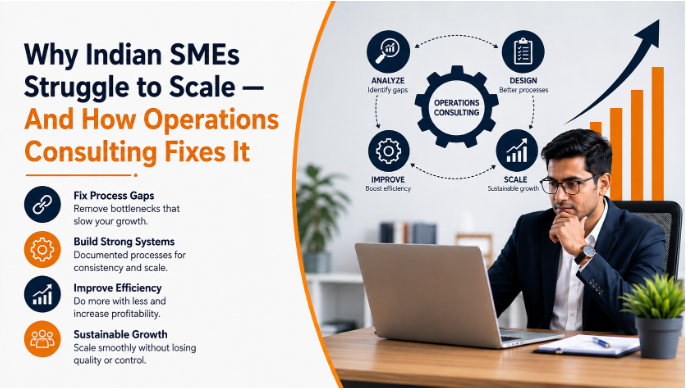
Business operations consulting is the practice of diagnosing, restructuring, and optimizing the internal processes of a company so it can handle growth without breaking down. For Indian SMEs, it’s often the missing link between a business that survives and one that actually scales sustainably.
The Real Reason Most SMEs Hit a Ceiling
Ask any SME owner in India what’s holding their business back, and you’ll hear a familiar list — lack of capital, market competition, talent shortage. Rarely do they say “our internal processes.”
But that’s usually the actual answer.
A business running on 10 employees with informal communication and founder-led decisions can move fast and stay agile. The same business at 40 employees, with three times the transaction volume, tends to collapse into confusion. Deadlines get missed. Quality drops. The founder is buried in calls that shouldn’t require them.
This isn’t a leadership failure. It’s an operational gap — and it shows up almost predictably once a business crosses certain growth thresholds.
According to a CII report on MSME challenges in India, over 60% of small businesses that stall during a growth phase cite internal process inefficiencies as a primary reason — not external market conditions. The foundation simply wasn’t built to carry the weight being placed on it.
Four Signs Your Operations Are Already Behind Your Growth Ambitions
You don’t need a consultant to tell you something’s wrong. The signals are usually right in front of you:
- The founder is still the last word on routine decisions
If daily operational calls still need your approval, the business runs at your personal speed — which is a hard ceiling on scale. - Knowledge lives in people’s heads, not documented systems
When your best employee leaves, how much walks out with them? If the honest answer is “a lot,” that’s a structural risk, not just a personnel problem. - Quality slips whenever volume goes up
If a good month for sales is also a stressful month for delivery, your current processes were built for a smaller load. They weren’t designed to scale. - You track revenue but not operational health
Revenue tells you what happened. Metrics like error rates, delivery timelines, and complaint patterns tell you what’s about to happen. Without them, you’re steering by looking in the rearview mirror.
What Process Optimization Actually Looks Like
Process optimization isn’t about copying what large corporations do. It’s about understanding what your business actually does today — not what the org chart says should happen — and building smarter systems around the reality.
The sequence that works, practically:
- Map current-state processes honestly. Document what’s actually happening across your key functions. Most businesses are surprised by what this reveals.
- Prioritize by business impact. Not every inefficiency needs fixing right away. Two or three targeted fixes often unlock more capacity than an overhaul attempted all at once.
- Convert tribal knowledge into documented SOPs. Standard operating procedures aren’t bureaucracy — they’re what lets you onboard new hires faster, maintain quality consistently, and reduce founder dependency.
- Set leading indicators, not just lagging ones. Tracking the right operational metrics lets you catch problems before they become customer-facing crises.
This is exactly the kind of structured intervention that a skilled business operations consultant brings to SMEs — not generic frameworks, but practical fixes built around your specific bottlenecks.
Why Fixing Operations Before You Scale Is Always Cheaper
There’s a reason experienced operators consistently say the same thing: fix the foundation before you add more floors.
Fixing operational gaps after rapid growth means doing it under pressure — mid-crisis, with customers already impacted and employees already frustrated. The cost of fixing things reactively is almost always higher, both financially and in terms of management bandwidth.
The SMEs that scale smoothly are the ones that addressed process gaps proactively. They weren’t perfect before scaling — no business is — but they had the fundamentals in place: documented systems, clear accountability, operational metrics they actually tracked.
According to McKinsey research on SME scaling, companies with structured operational foundations grow 20–30% faster on average than those without, while experiencing significantly fewer operational breakdowns during high-growth periods. That’s not a coincidence. Structured operations create compounding returns — every new hire onboards faster, every new client is served more consistently, every problem gets caught earlier.
The Consulting Approach That Works for Indian SMEs
Indian SMEs have a unique business context. Decisions often need to move fast. Resources are limited. Margins for error are thin. And founders are usually doing three jobs simultaneously.
A consulting approach that doesn’t account for these realities isn’t useful — it’s a theoretical exercise that sits in a report and never gets implemented.
Effective business operations management consulting for Indian SMEs works differently. It identifies the 2–3 changes that will have the highest practical impact, designs systems the team can actually follow, and builds operational habits that persist after the engagement ends.
The goal isn’t a perfect process on paper. It’s a business that runs better than it did before — with the operational capacity to actually absorb the growth you’re planning for.
If your business has growth ambitions that your current operations aren’t equipped to support, the right time to address that is before the next push — not after it stalls.
The author writes on business growth, operations strategy, and SME scaling challenges across
About The Author
Mr. Varun Surana is one of India’s most trusted business operations management consultants, known for helping Indian SMEs build the operational foundations they need to scale without breaking down. Businesses that work with Varun gain structured processes, reduced founder dependency, and the systems needed to grow sustainably. With hands-on experience across diverse industries, he brings practical, no-jargon solutions to real operational challenges — helping business owners move from firefighting every day to actually leading their growth.