
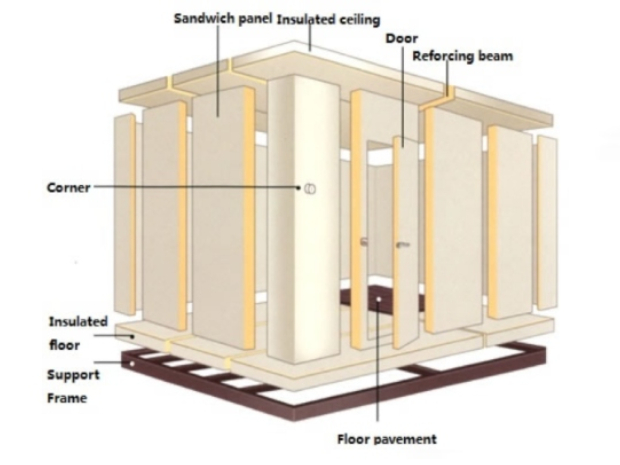
Food manufacturers, warehouses, and logistics operators in Singapore weighing a new cold storage investment increasingly find themselves choosing between two approaches: modular cold storage solutions built from prefabricated insulated panels, or a traditionally constructed cold room built on-site to a bespoke specification. Both can deliver reliable temperature control, but they differ meaningfully on installation speed, scalability, and total cost of ownership.
Installation Speed
Modular systems are manufactured off-site in parallel with site preparation, meaning assembly itself is largely a matter of fitting pre-made panels together once delivered. A traditional cold room build involves sequential on-site work — structural preparation, insulation, and refrigeration installation typically can’t run in parallel — which extends the overall timeline, particularly for larger or more complex spaces.
Scalability
This is where modular systems have a clear edge. Because the structure is built from standardized panels, expanding capacity or relocating to a new site later is largely a matter of adding or reassembling panels rather than new construction. A traditional cold room’s scalability depends heavily on whether the original design planned for future expansion, which isn’t always the case.
Total Cost of Ownership
Upfront costs can favour either approach depending on project scale — modular systems often have a cost advantage for small to mid-sized installations, while very large traditional builds can sometimes achieve a lower cost per cubic metre. Where the comparison shifts is long-term flexibility: a business that later needs to relocate or reconfigure a modular system generally faces lower costs than one needing to modify a fixed structure.
Which Approach Fits Your Business?
Businesses on shorter leases, still scaling, or uncertain about long-term site tenure tend to be better served by modular cold storage, given the flexibility to relocate or reconfigure later. Businesses with a confirmed long-term site or unusually large storage requirements may find a traditional build, handled by an experienced contractor, delivers better value at scale. Some operators also start with a reefer container-based solution to validate volume requirements before committing capital to either path — a route AML supports alongside its reefer container fleet maintenance services for businesses already operating a fleet.
There isn’t a universally correct answer between modular and traditional cold storage — the right choice depends on your site constraints, growth trajectory, and how much flexibility you need over the next several years. Getting clarity on these factors before committing capital is the most reliable way to avoid an expensive mismatch between your cold storage investment and how your business actually operates.
Energy Efficiency Over Time
Both approaches can be built to a similar insulation standard, but it’s worth asking any contractor how they expect thermal performance to hold up over the system’s operating life. Factory-sealed modular panel joints sometimes maintain consistent performance more reliably than site-applied insulation, which can degrade unevenly if not installed with equal care across every section of a traditional build — a factor worth weighing alongside upfront cost when comparing long-term running expenses across the two approaches over a ten-year horizon.