
Traditional automation is reaching its limit. Modern web applications built with React, Vue, Angular, and Next.js change too fast for static scripts. QA teams lose 30-50% of their time maintaining brittle tests. Developers spend cycles fixing selectors instead of shipping product.
That model no longer scales.
Regression testing is moving from assistive AI to autonomous AI. That shift matters. AI Copilots help you write tests faster. AI Agents take ownership of discovery, execution, adaptation, and coverage. In regression testing, that is the difference between speeding up manual work and removing it.
Copilot vs. Agent
Most AI testing products still behave like Copilots. They wait for prompts. They suggest code. They depend on humans to define flows, manage selectors, and maintain suites.
AI Copilots:
- Reactive: Respond to instructions.
- Assistive: Help you generate Playwright or Cypress code.
- Human-led: Depend on engineers for logic, maintenance, and execution.
- Limited impact: Reduce typing. Not operational load.
AI Agents:
- Proactive: Start from goals like “test checkout” or “validate onboarding flow.”
- Autonomous: Discover pages, forms, buttons, and paths without manual mapping.
- Adaptive: Recover from UI changes and continue execution.
- Operational: Reduce routine test engineering work at system level.
The distinction is simple. A Copilot helps create tests. An Agent helps ensure software still works.
For a broader definition of agentic systems, see Agentic AI.
Why Scripted Automation Breaks Down
Maintenance is the hidden tax in regression testing. Every refactor, DOM change, renamed class, or layout update creates new failure points. Traditional end-to-end suites depend on selectors and structure staying stable. Modern frontends do not stay stable.
That is why teams end up with a paradox. They invest in automation for speed, then slow down to maintain it.
Agentic AI changes the operating model. Instead of relying only on static selectors, the system evaluates intent. It identifies what the user is trying to do. It finds the right control based on context, semantics, and page state. That makes tests more resilient across UI change.
How Agentic AI Handles Regression
Autonomous regression systems work in continuous loops, not fixed scripts.
1. Discover application surface
Agentic systems crawl your application like a user. They map routes, identify forms, detect interactive elements, and uncover paths humans often miss. Coverage expands by default.
2. Execute with context
Agents do not just replay steps. They interpret page structure and user intent. If a button moves, a menu changes, or a form shifts location, the system adapts instead of failing immediately.
3. Heal around change
When a known interaction breaks, the agent reevaluates current page state. It identifies equivalent elements and updates execution logic. That cuts maintenance overhead and keeps suites useful after releases.
4. Extend beyond pass/fail
Modern regression testing should not stop at click validation. Autonomous systems can also inspect page quality signals like accessibility, SEO, security posture, and UX consistency. That turns regression into a broader quality control layer.
Why This Matters Now
Release velocity keeps increasing. Frontend stacks keep changing. Teams need broader coverage without adding more maintenance burden.
That is why agentic testing is not just a feature trend. It is a workflow shift.
The strongest platforms combine autonomy with control. Teams still need exportable code, pipeline integration, and visibility into what the system tested. That is the practical path forward: autonomous execution with engineering-grade transparency.
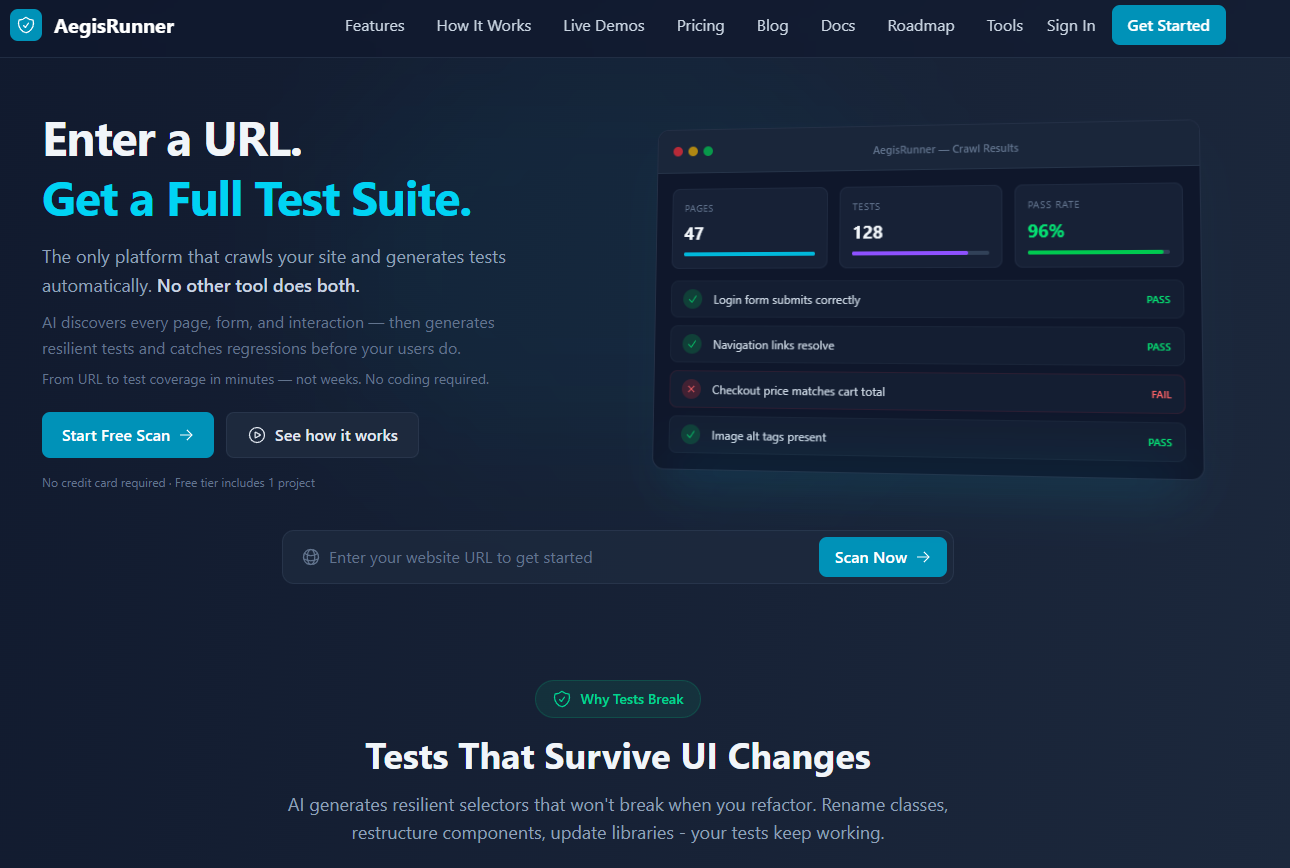
AegisRunner is built around that model. It discovers application flows automatically, runs regression checks with resilient selectors, and supports export to clean Playwright scripts for CI/CD and customization. More product and technical content is available on the AegisRunner blog.
Conclusion
AI Copilots improved how teams write tests. AI Agents improve how teams operate testing.
That is the future of regression automation.
The next generation of testing platforms will not wait for instructions on every change. They will discover, decide, execute, and adapt. Teams that adopt that model get faster releases, stronger coverage, and far less maintenance drag.
Autonomous regression testing is becoming standard for modern web engineering.