
Pump cavitation is one of the most destructive phenomena in fluid handling systems. It occurs when local fluid pressure drops below the vapour pressure of the liquid, causing vapour bubbles to form and then collapse violently as they move into higher-pressure regions. The energy released by collapsing cavitation bubbles is sufficient to erode hardened steel impellers within months, produce noise levels comparable to gravel moving through the pump, and cause bearing failures through vibration-induced fatigue.
Most maintenance teams treat cavitation as a pump problem. In reality, cavitation is almost always a system problem — and in a large proportion of cases, the root cause is inadequate fluid filtration upstream of the pump inlet.
How Blocked Strainers Cause Cavitation
The connection between strainer condition and pump cavitation is pressure drop. Every strainer introduces resistance to flow, and that resistance increases as the mesh accumulates debris. A clean basket strainer with a 40-mesh screen might impose 0.1 bar pressure drop at design flow. The same strainer with mesh 30% blocked by debris can impose 0.4–0.6 bar — enough to reduce the Net Positive Suction Head Available (NPSHa) below the pump’s Net Positive Suction Head Required (NPSHr) and trigger cavitation.
The problem is compounded by the fact that partial blockage is invisible during normal operation. The pump appears to be running normally — flow is maintained, discharge pressure is within range — but noise and vibration are elevated and impeller erosion is proceeding faster than scheduled maintenance intervals would predict.
Following structured maintenance checklists for basket strainers prevents the partial blockage conditions that raise inlet pressure drop and accelerate cavitation risk in downstream pumps. The key is not cleaning the strainer after cavitation symptoms appear — it is cleaning it before differential pressure reaches the threshold where NPSHa is compromised.
Understanding NPSHa and Its Relationship to Filtration
NPSHa is the absolute pressure available at the pump suction flange, expressed as a head of liquid above vapour pressure. It is determined by the suction vessel pressure, the liquid vapour pressure at operating temperature, the vertical distance between the liquid surface and the pump centreline, and the friction losses in the suction piping — of which the strainer pressure drop is a component.
For cold water at moderate temperatures, NPSHa margins are generous and a partially blocked strainer causes noise and vibration but not immediate cavitation. For hot liquids, condensate, and fluids close to their boiling point, the margin between NPSHa and NPSHr is thin, and even modest increases in strainer pressure drop can push the system across the cavitation threshold.
The Hydraulic Institute standards for pump installation recommend that strainer pressure drop at maximum flow be included in all NPSHa calculations, and that the calculation use the blocked strainer pressure drop — not clean condition — to represent worst-case field conditions. In practice, this means strainer selection must be based on the available NPSHa margin, not just on rated flow capacity.
Choosing the Right Strainer for Your Application
Not all strainers are equivalent in their impact on pump cavitation risk. The key selection parameters are mesh size, free area ratio, and body size. Selecting an appropriately sized y strainer for your installation means specifying a strainer whose body is large enough that the clean pressure drop at maximum flow is less than 0.1 bar — leaving adequate margin for partial blockage before NPSHa is compromised.
Mesh size should be selected based on what the pump impeller and mechanical seal can tolerate, not on the finest particles in the fluid. Over-specified mesh (too fine) blocks faster, requires more frequent cleaning, and imposes higher clean pressure drop. For centrifugal pumps in general service, 20–40 mesh (425–850 micron) is typically appropriate. Finer mesh should only be specified where downstream equipment genuinely requires it.
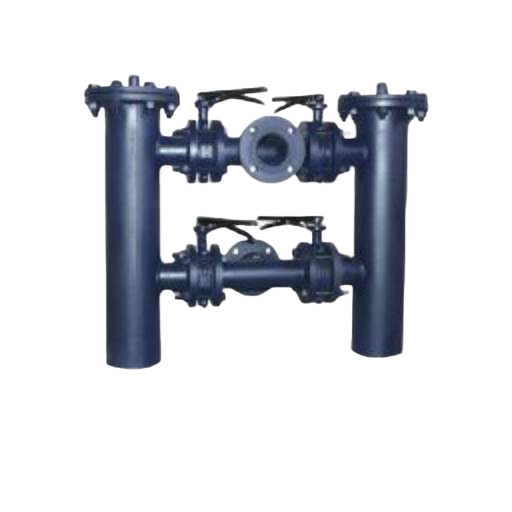
Duplex basket strainers — with two parallel baskets and a diverter valve — allow online cleaning without interrupting pump operation. In continuous service applications where stopping the pump for strainer cleaning is operationally disruptive, the premium over simplex construction is easily justified.
Differential Pressure Monitoring
The most effective way to prevent cavitation from strainer blockage is continuous differential pressure monitoring across the strainer. A differential pressure transmitter with a high-DP alarm set at 70% of the calculated clean-to-blocked pressure rise provides advance warning before NPSHa is compromised.
In systems without automated monitoring, a simple manual gauge is far better than no measurement at all. Operators who check differential pressure at the start of each shift and have a documented clean-out procedure when a threshold is reached prevent the majority of cavitation incidents caused by strainer blockage.
Maintenance Intervals and Differential Pressure Monitoring
Maintenance intervals for basket strainers should be based on differential pressure readings, not calendar time. A strainer serving a clean municipal water supply may only need annual inspection. The same strainer serving a system with corrosion products, biological growth, or process contamination may need weekly cleaning during certain operating seasons.
The maintenance record should log the as-found differential pressure at each inspection, the condition of the mesh (any damage, corrosion, or deformation), and the quantity and nature of accumulated debris. Changes in debris type or quantity often signal upstream system changes — new corrosion products, a failed filter upstream, or a change in fluid chemistry — that warrant investigation beyond the strainer itself.
Special Considerations for Hot Condensate Pumping
Condensate pump and return system applications represent the highest-risk scenario for strainer-induced cavitation. Condensate is typically at or near its boiling point, meaning NPSHa margins are minimal. Steam traps that have failed open introduce flash steam into the condensate return line, further reducing the effective NPSHa. Any additional pressure drop from a partially blocked strainer pushes the pump immediately into cavitation.
For condensate service, strainer cleaning intervals should be more frequent than in cold water service, and the NPSHa calculation should account for the worst-case flash steam contribution from upstream trap failures. Duplex strainers are strongly recommended.
Conclusion
Preventing pump cavitation requires looking upstream. In the majority of cases where cavitation develops in a previously well-performing pump, the root cause is an increase in suction-side pressure drop — and the most common single contributor is a partially blocked inlet strainer. A proactive filtration maintenance programme, built around differential pressure monitoring and condition-based cleaning intervals, is the most cost-effective protection available. Combined with regular steam trap inspection and survey to prevent flash steam ingress in condensate systems, it addresses the two most common causes of cavitation in process plant pumping applications